





Articles
and news

Purification of Monoclonal Antibodies Using Centrifugation and HPLC
Published on · Updated on
HPLC, or high-performance liquid chromatography, is an analytical technique used to separate, identify, and quantify the components present in a mixture. In laboratory settings, it is often combined with immunological techniques for the analysis of proteins, antibodies, and other biomolecules.
This combination is commonly used in biotechnology, biomedical research, and pharmaceutical development laboratories. Its applications include studying immune responses to infections or cancer and developing antibody-based treatments.
Analysis of Monoclonal Antibodies Using HPLC
One example of its application is the purification and analysis of monoclonal antibodies in biomedical research or therapy development projects. Although centrifugation is not directly involved in the chromatographic separation performed by HPLC, it can be used during sample preparation prior to analysis. A laboratory protocol for monoclonal antibody analysis may include the following stages:
- Collection of serum or cell fluid: First, the biological sample containing the antibodies to be analysed is obtained.
- Immunoprecipitation for antibody capture: The sample is brought into contact with beads coated with antigens that are specific to the antibody of interest. It is then centrifuged at speeds ranging from 3,000 to 10,000 rpm for 5–15 minutes at a temperature of 4 °C. This process causes the beads that have captured the antibodies to precipitate, facilitating their separation from the other components of the sample.
- Antibody recovery: After centrifugation, the antibodies are separated from the beads used during immunoprecipitation.
- Purification and analysis by HPLC: Finally, the recovered antibodies are purified and analysed using high-performance liquid chromatography.
Centrifugation Prior to HPLC Analysis
Sample preparation for HPLC in an immunology laboratory may require the simultaneous processing of different sample volumes and numbers of tubes while maintaining controlled temperature conditions. The Bioprocen 22 R refrigerated centrifuge can accommodate configurations of 24, 30, or 48 microtubes, depending on the size of the laboratory and the requirements of each protocol.
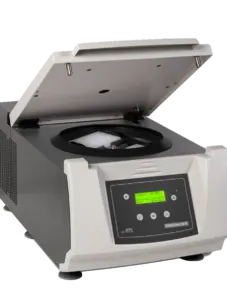
Its refrigeration system ensures that a temperature of 4 °C is maintained even at maximum centrifugation speed, making it particularly suitable for immunoprecipitation protocols and the preparation of biological samples that are sensitive to temperature variations.
This combination of capacity, flexibility, and temperature control makes the Bioprocen 22 R a suitable option for immunology laboratories and for sample preparation processes prior to antibody analysis by HPLC.
Although monoclonal antibody analysis is only one of its possible applications, HPLC and the preceding preparation stages, including centrifugation, are commonly used in immunological research. These procedures contribute to the study of immune responses and the development of treatments based on biomolecules and antibodies.