





Articles
and news

Detection of feline leukaemia virus (FeLV) using IFA
Published on · Updated on
Feline leukaemia virus (FeLV) affects cats exclusively and is responsible for some of the most serious infectious diseases in felines, as it can cause a wide range of health problems. To date, there is no definitive cure, although palliative treatments are available. Effective diagnostic methods are therefore essential for its detection.
FeLV diagnostic methods
The main methods used to diagnose FeLV are ELISA, IFA and RT-PCR. Of these three, the indirect immunofluorescence assay (IFA) is the only technique that can determine whether a cat has a systemic FeLV infection.
IFA testing for FeLV detects the presence of the viral p27 antigen within leukocytes and erythrocytes. Its detection in these cells indicates that the virus has already replicated and entered the bloodstream, indicating a persistent infection.
General IFA protocol and sample preparation
The general IFA protocol for detecting feline leukaemia virus consists of the following steps:
- A blood sample of approximately 2 ml is collected.
- The sample is centrifuged at a relative centrifugal force of 1,000–1,500 × g for approximately 10 minutes to separate the plasma, buffy coat and erythrocytes.
- The buffy coat is collected using a pipette and resuspended in PBS.
- The sample is placed on a microscope slide, and two antibodies are added: one specific to the viral antigen and another specific to the first antibody, labelled with a fluorescent molecule.
- The sample is examined under a microscope. If fluorescence is detected, the sample is considered positive for FeLV.
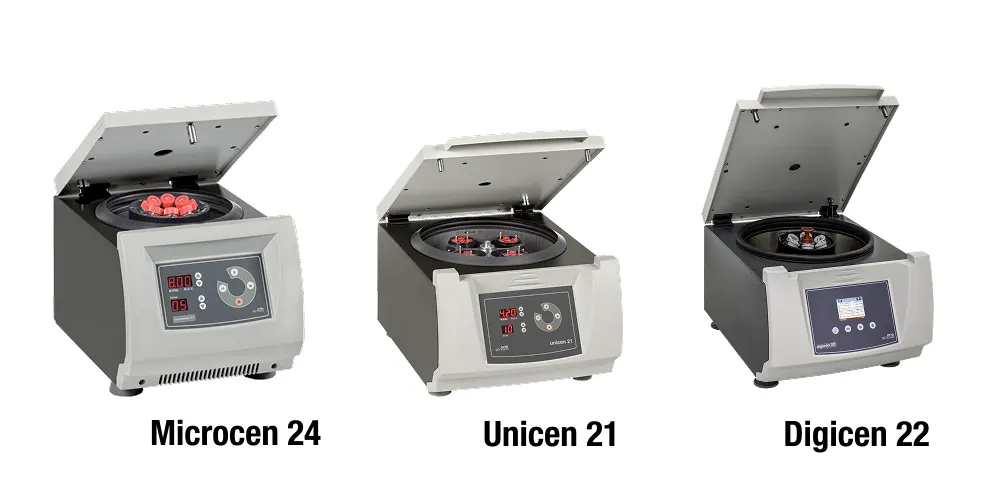
For centrifuging the blood samples used in this protocol, we offer equipment such as the Microcen 24 and more versatile options, such as the Unicen 21 or Digicen 22, depending on processing requirements and laboratory size.
IFA is a straightforward method, although it requires a sequence of controlled steps to obtain fast, reliable results. Blood sample centrifugation forms part of this preparation, separating the fractions that will be used in the analysis.